


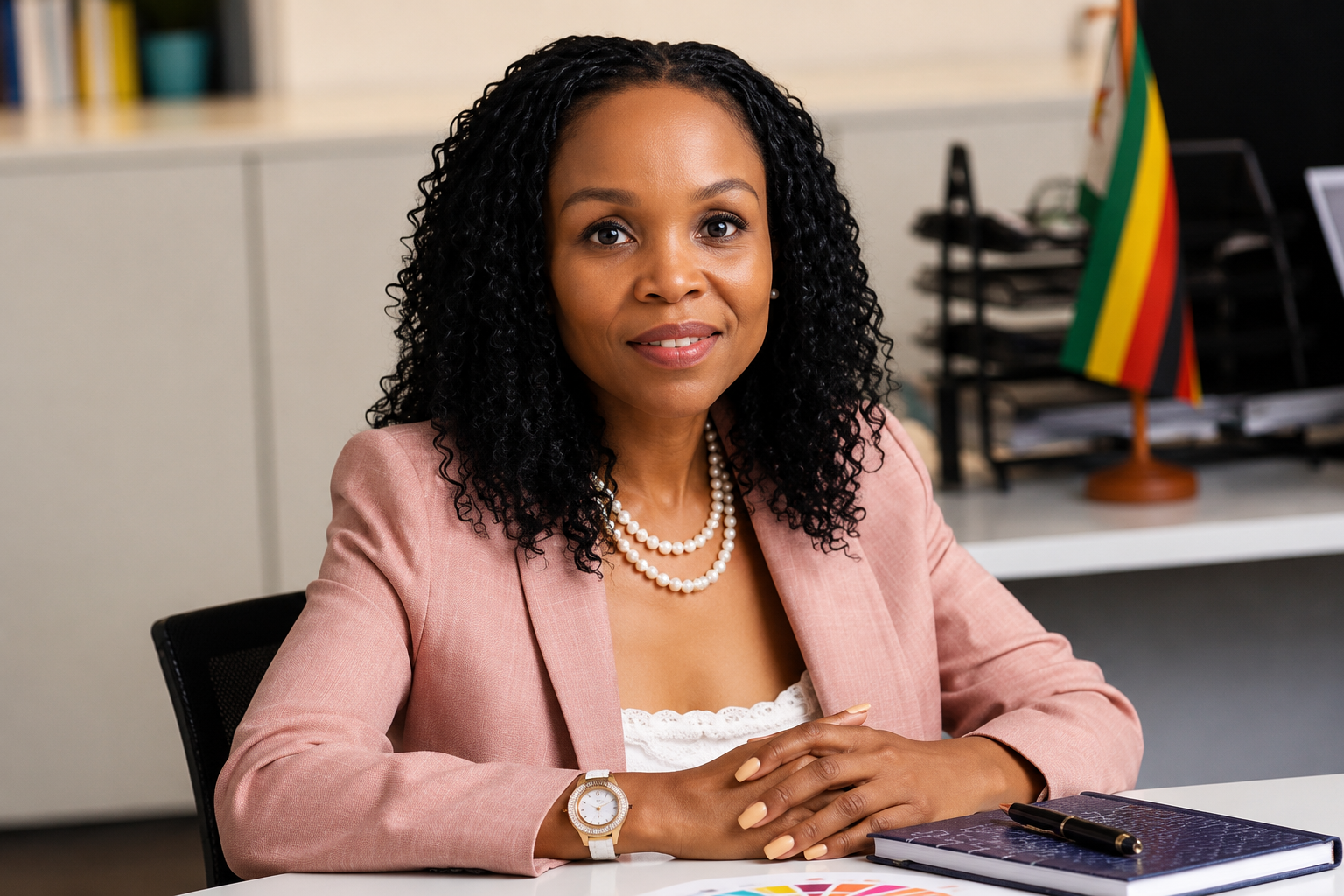
Philile Masuku on youth unemployment, informality and the future of work in Zimbabwe
The Diplomat Couch sat down with Philile Masuku, ILO Country Director for Zimbabwe, a labour governance specialist whose work on social dialogue, skills development and the transition to formality informs the organisation’s support for decent work, social protection and inclusive labour markets. In this edited interview, she reflects on the state of Zimbabwe’s labour market, youth unemployment, the informal economy and the opportunities emerging from green and digital transitions. The Diplomat Couch is a TV program produced by The Diplomat Africa.
What does the ILO’s mission mean for workers in Zimbabwe today?
Thank you very much. The ILO’s core mandate is to promote decent work and social justice and internationally recognised human and labour rights. At the heart of our work is the belief that all people should have access to productive work that provides dignity, equality, fair income, security and social protection.
It balances four strategic pillars: job creation, rights at work, social protection and social dialogue.
We bring together governments, employers and workers to shape labour policies that are fair, practical and inclusive.
In Zimbabwe, this mandate is especially relevant because the labour market is undergoing major shifts that are reflected, among others, in the lives of youths, women, workers and enterprises in the informal economy. We are working with national stakeholders to formulate policies and programmes to expand opportunities for decent jobs, strengthen labour market institutions, support young people and women, improve social protection and promote dialogue among social partners.
Our role is not only normative and technical, but also catalytic: we help build consensus around reforms and actions that can improve people’s lives and support sustainable development.
What are the priorities of the ILO’s work in Zimbabwe?
In practice, an ILO country programme, typically called a Decent Work Country Programme (DWCP), focuses on priority areas derived from national development objectives and defined by our tripartite partners in government, employers’ organisations and workers’ organisations.
These priorities are centred on four pillars: employment creation, rights at work, social protection and social dialogue.
The programme combines policy advice, technical assistance, capacity building, labour market research, support to legal and institutional reform, and dialogue among government, business and workers’ organisations.
Zimbabwe’s current Decent Work Country Programme, which runs from 2022 to 2026, focuses on promoting more inclusive employment, strengthening labour institutions and tripartite dialogue, improving the application of international labour standards and extending social and labour protection.
How would you describe Zimbabwe’s labour market today?
From a world-of-work perspective, the defining feature of Zimbabwe’s labour market is the contrast between great potential and significant structural constraints.
Zimbabwe’s labour market is dominated by informality. Around 76.1 per cent of enterprises are informal, while 65 per cent of employed persons work in the informal sector.
This tells us two things. It tells us that people are finding ways to survive and create livelihoods, but it also tells us that many workers are doing so in the face of decent work deficits, including inadequate protection, low incomes, insecurity and unsafe working conditions.
We also have a youthful population. More than 67 per cent of the population is under 35, yet close to half are not in employment, education or training. This presents enormous potential if the right investments are made in education, skills, entrepreneurship and job-rich sectors.
At the same time, there are challenges related to unemployment, underemployment, job quality, low wages, skills mismatches and limited social protection coverage.
Our role is to help turn that potential into inclusive and sustainable labour market outcomes.
When we talk about “decent work”, what does that actually mean?
The ILO’s Decent Work Agenda rests on four pillars: jobs, rights at work, social protection and social dialogue.
From these pillars, we derive a framework of indicators that measure not only whether people are working, but whether work is decent, inclusive and sustainable.
These indicators look at employment opportunities and stability, adequate earnings, productive work, working time, work-life balance, child and forced labour, job security, equality of opportunity, workplace safety, social security and workplace relations.
The objective is to ensure that work provides dignity, protection and opportunity, not merely income.
What are the biggest obstacles to decent work today?
According to the ILO’s World Employment and Social Outlook report, some of the biggest challenges include the limited number of productive jobs, especially for young people and women, the scale of informality and gaps in social protection coverage.
Many workers remain outside formal regulatory and protection systems. Productivity and labour income growth are often insufficient to advance decent work, even where economies are growing.
Skills mismatches, constrained enterprise growth and limited labour market information also make it harder to connect people to opportunities.
In some cases, implementation capacity is another challenge. Good policies may exist, but translating them into consistent outcomes for workers and businesses requires strong institutions, adequate resources and continuous social dialogue.
Despite the challenges, where is progress being made?
Globally, child labour, extreme poverty and work-related mortality have all declined over the past three decades, while social protection coverage has expanded.
In Zimbabwe, we are seeing encouraging efforts around employment promotion and the transition to formality through the adoption of a National Formalisation Strategy and a National Employment Policy.
Promotion of gender equality in the world of work is another area where progress has been made, including efforts to reduce violence and harassment and strengthen workplace responses to HIV and AIDS.
There is also greater openness to collaboration among government, workers, employers and development partners. We are seeing growing recognition that employment quality matters, not just employment quantity.
That matters because durable progress comes when reforms are nationally owned and collectively shaped.
Why are so many young Zimbabweans struggling to find work?
Young people face several barriers, including the limited availability of quality jobs relative to the number of labour market entrants.
In Zimbabwe, around 50 per cent of young people aged between 15 and 35 are not in employment, education or training. Many also face barriers related to access to finance, business development support, digital tools and professional networks.
For young women, there may be additional constraints linked to unpaid care responsibilities, safety concerns or social norms.
Youth employment is not only about creating jobs. It is also about removing the structural barriers that prevent young people from accessing and sustaining them.
Is Zimbabwe facing a skills crisis or a jobs crisis?
Skills mismatch is one of the biggest concerns of our time because it hinders economic growth, lowers productivity and fuels youth unemployment.
In many labour markets, including Zimbabwe’s, there can be a disconnect between the skills young people are acquiring and the skills employers or emerging sectors need.
However, skills mismatches do not always explain why employers struggle to fill vacancies or why young people fail to find work. In many cases, uncompetitive wages, poor working conditions and the actual lack of jobs are the primary causes.
Skills development therefore has to be dynamic. Skilling, reskilling and upskilling throughout life are essential for helping people adapt to changing labour markets and seize new opportunities.
How can training systems better prepare young people for the jobs of the future?
The ILO works with government, employers, workers’ organisations, training institutions and development partners to strengthen the relevance of skills systems.
This includes supporting labour market assessments, promoting dialogue between training providers and industry, and helping design demand-driven and inclusive training programmes.
We also support work-based learning, entrepreneurship development and the integration of life skills and digital skills into training pathways.
The objective is to ensure that training is connected to real opportunities in the economy. Skills systems are most effective when they are informed by evidence, shaped by social partners and responsive to change.
Where do you see the biggest opportunities for young people?
Important opportunities are emerging in areas such as the green economy, digital services, agribusiness, value addition, creative industries and care-related services.
These sectors have the potential to create jobs, foster innovation and support more sustainable growth.
We are also seeing opportunities linked to entrepreneurship and micro-enterprise development, particularly where young people can access training, finance and markets.
The key is ensuring that young people are aware of these opportunities and equipped to seize them.
What does the transition from informality to formality really look like?
We engage with the informal economy as a lived reality for millions of workers, not as a side issue.
For many people, informal work is the main source of livelihood. Our approach is therefore to support policies and programmes that improve productivity, incomes, occupational safety and health, rights awareness, access to social protection and representation.
The recently adopted Formalisation Strategy seeks to create pathways that help workers and enterprises transition into the formal economy.
For workers, transition to formality means greater labour protection, access to social security and stronger rights. For enterprises, it means legal recognition, registration and compliance with regulatory requirements while benefiting from the opportunities that formalisation can bring.
Why do labour standards matter in everyday working life?
International labour standards provide an important framework for fairness, stability and inclusive development.
In Zimbabwe, the ILO works with stakeholders through technical assistance, policy dialogue, capacity building and training to ensure these standards are reflected in laws, institutions and workplace practices.
These standards cover issues such as freedom of association, collective bargaining, the elimination of forced labour, the abolition of child labour, non-discrimination and workplace safety.
When national systems align with these standards, both workers and the economy benefit.
Where do workers remain most vulnerable?
Workers in informal settings, domestic work, agriculture and other forms of precarious employment often face the greatest challenges.
These workers may struggle to access written contracts, social insurance, safe working conditions, representation and effective dispute resolution.
Another challenge is ensuring that labour rights keep pace with changing labour markets. As economies become more digital and more environmentally conscious, labour governance systems must evolve so that new forms of work do not become new forms of exclusion.
Why should social protection be viewed as an economic investment rather than a cost?
Social protection is not only about protection; it is also about productivity, resilience and sustainable economic development.
When people have a basic level of security, they are better able to invest in education, health, livelihoods and enterprise.
Social protection can also serve as an economic stimulus during times of crisis. Evidence shows that more than US$1.50 is generated for every US$1 invested in social protection.
In that sense, social protection is both a social imperative and an economic investment.
How do we ensure workers benefit from green and digital transitions?
Workers will not be left behind if countries plan transitions early, invest in skills, strengthen social protection and institutionalise social dialogue.
Transitions must be managed, not assumed.
Employers and workers need to be consulted in the formulation and implementation of policies related to artificial intelligence, climate change and technological change.
It is also important to ensure that women, youth, informal workers, rural communities and smaller enterprises are included. Inclusion must be designed into the transition from the beginning.
What would success look like for Zimbabwe’s labour market ten years from now?
My vision is for a labour market that is more inclusive, more productive and more resilient.
I would like to see more young people entering meaningful work, more women accessing equal opportunities, more enterprises growing sustainably and more workers enjoying protection and voice.
I would also like to see progress in the transition from informality to formality, stronger labour market institutions, wider social protection coverage and skills systems that are better aligned with the future of work.
Above all, the goal is a labour market that delivers dignity and opportunity for all while supporting Zimbabwe’s broader development aspirations.
What is your message to the next generation of workers?
Your future matters, and your talent matters.
Opportunities are changing, not disappearing. Continue to invest in your skills, remain open to learning and do not underestimate the value of resilience, creativity and integrity.
The world of work is changing, but there will always be space for people who are adaptable, committed and prepared to grow.
I would also encourage young people to see themselves not only as jobseekers, but as problem-solvers, innovators and active citizens. Your voice is important in shaping the kind of economy and society you want to inherit.