

Diplomatic relations are built between governments, but their true impact is often felt in the connections they create between people. For Zimbabwe and Brazil, the strength of their longstanding friendship is increasingly being measured by the opportunities it creates for farmers, students, businesses and communities.
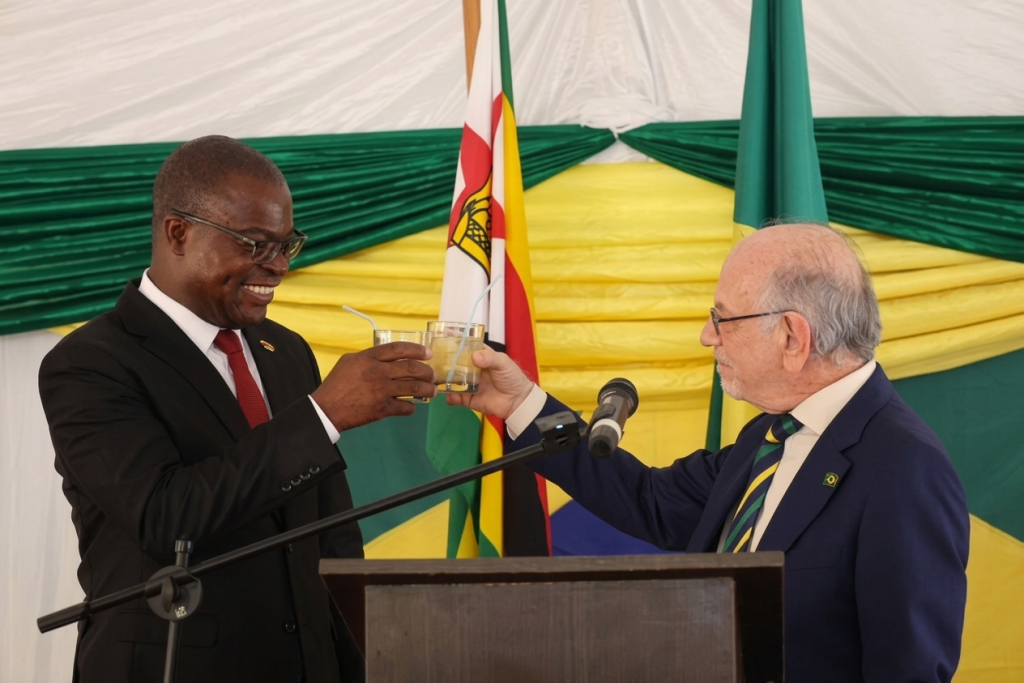
That people-centred dimension came into focus during Brazil’s National Day celebrations in Harare. Beyond the formalities of diplomacy, the occasion reflected a broader ambition: translating decades of political goodwill into practical partnerships in trade, agriculture, education and culture — and ultimately into opportunities that improve lives and bring the people of Zimbabwe and Brazil closer together.
Foreign Affairs and International Trade Minister Prof. Amon Murwira pointed to Brazil’s support through the More Food International Programme, which he said had provided technical expertise and equipment that contributed to the mechanisation of Zimbabwe’s agricultural sector and efforts to strengthen food security.
The cooperation has also extended to cotton development, pasture and livestock management and the sugar industry, demonstrating how a diplomatic relationship can translate into technical partnerships within productive sectors.
“We are committed to economic diplomacy that expands trade, attracts investment and secures technology exchanges to build national productivity and resilience of the global economic system,” Murwira said.
It is this movement from diplomatic engagement to practical cooperation that could define the next phase of relations between Harare and Brasília.
Brazil’s agricultural experience offers Zimbabwe opportunities to access knowledge, technology and expertise, while closer commercial ties could create space for investment and trade between businesses in the two countries. Brazilian Ambassador Vilmar Rogeiro Coutinho Jr said efforts were already underway to strengthen that side of the relationship through planned Brazilian trade missions to Zimbabwe.
Yet the two countries recognise that economic cooperation cannot grow in isolation from greater interaction between their people.
For years, the relationship has been characterised by political goodwill, but relatively limited trade, investment and knowledge of each other’s societies. Coutinho acknowledged this gap, saying that despite the sympathy between the two peoples, “there is still insufficient mutual knowledge of history and cultural aspects, and few trade and investment links.”
Changing that reality requires more than diplomatic meetings. It requires people to travel, businesses to meet, students to study together and artists and sporting communities to interact.
That is why discussions around easing movement between the two countries have taken on wider significance. Zimbabwe is progressively working with Brazil on visa arrangements, beginning with official and diplomatic passport holders, while both sides have expressed interest in broader cooperation.
“Therefore, why do we need visas? We need visits, not visas,” Murwira said.
For Zimbabwe, greater movement could strengthen tourism while opening opportunities for cultural and commercial exchanges. Murwira invited Brazilian tourists and hospitality businesses to explore destinations including Victoria Falls, Great Zimbabwe and the Matobo Hills.
“When we visit each other, we know each other better. And when we know each other better, we foster a better world for all,” he said.
Culture is already providing another bridge. Coutinho announced that Brazilian artists and producers are expected to participate in the Harare Fringe Theatre Festival this September, following the participation of Zimbabwean artist Moffat Takadiwa at the São Paulo Biennial.
Sport is similarly creating new points of contact, with the ambassador highlighting the presence of a Brazilian international footballer playing for a Zimbabwean team.
These exchanges may appear modest compared with formal diplomatic agreements, but they address one of the gaps identified by the ambassador: limited mutual knowledge between the two societies.
Education could provide an even more lasting connection. Zimbabwe and Brazil are working towards completing an agreement on higher education that is expected to provide a framework for academic exchanges, scholarships, joint research and capacity building.
Murwira said the partnership could help in “blending Brazilian technological expertise with our educational institutions to build a knowledge-driven society.”
Such cooperation has the potential to connect Zimbabwean students and researchers with Brazilian institutions while creating opportunities for knowledge and technology exchange.
The relationship also carries weight on the international stage. Brazil supported Zimbabwe’s successful election as a non-permanent member of the United Nations Security Council for 2027–2028, reinforcing the political alignment between the two countries on multilateral issues.
“Zimbabwe and Brazil stand shoulder to shoulder in their commitment to a fair international order,” Murwira said.
Coutinho said Brazil would continue to engage Zimbabwe on international issues as it prepares for its Security Council mandate, wishing the country “full success during the country’s tenure at the United Nations Security Council.”
Zimbabwe’s interest in BRICS provides another avenue for cooperation. Murwira said the country was looking forward to joining the grouping after its admission to the BRICS Bank, while Coutinho expressed hope that Zimbabwe would eventually be recognised as a full or associated member.
For Brazil, the relationship with Zimbabwe is also part of a wider connection with Africa. Coutinho noted that “half of the Brazilian population is Afro-descended,” underscoring the cultural and historical links that give the relationship a dimension beyond conventional diplomacy.
“I sincerely hope that soon Zimbabwe will officially be recognized as a new either full or associated member of the BRICS,” Ambassador Coutinho said.
The challenge now is to convert these shared interests into sustained results. The agricultural programmes, proposed trade missions, education agreement, visa arrangements and cultural exchanges provide building blocks, but their significance will ultimately depend on how effectively they translate into opportunities beyond government-to-government relations.
For two countries that have maintained diplomatic ties since Zimbabwe’s independence in 1980, the friendship is well established. What is changing is the emphasis: from simply celebrating the relationship to finding new ways for it to produce practical benefits.
As Murwira put it: “We look forward to a future of deeper trade, greater technology exchange, for shared prosperity.”
The future of Zimbabwe-Brazil relations may therefore be defined not by the number of diplomatic engagements held, but by how successfully the two countries turn their political goodwill into stronger economies, greater knowledge exchange and closer connections between their people.