
Two new Global Gateway projects are bringing European and South African institutions together to mobilise investment, strengthen local value chains and turn South Africa’s renewable energy and mineral resources into jobs, skills and industrial opportunities.
TAURAI MHAKA
South Africa’s ambitions in green hydrogen and critical minerals received a further investment boost with the launch of two Team Europe projects worth more than R1 billion, aimed at moving the country beyond resource extraction towards greater local value addition, industrial development and employment.
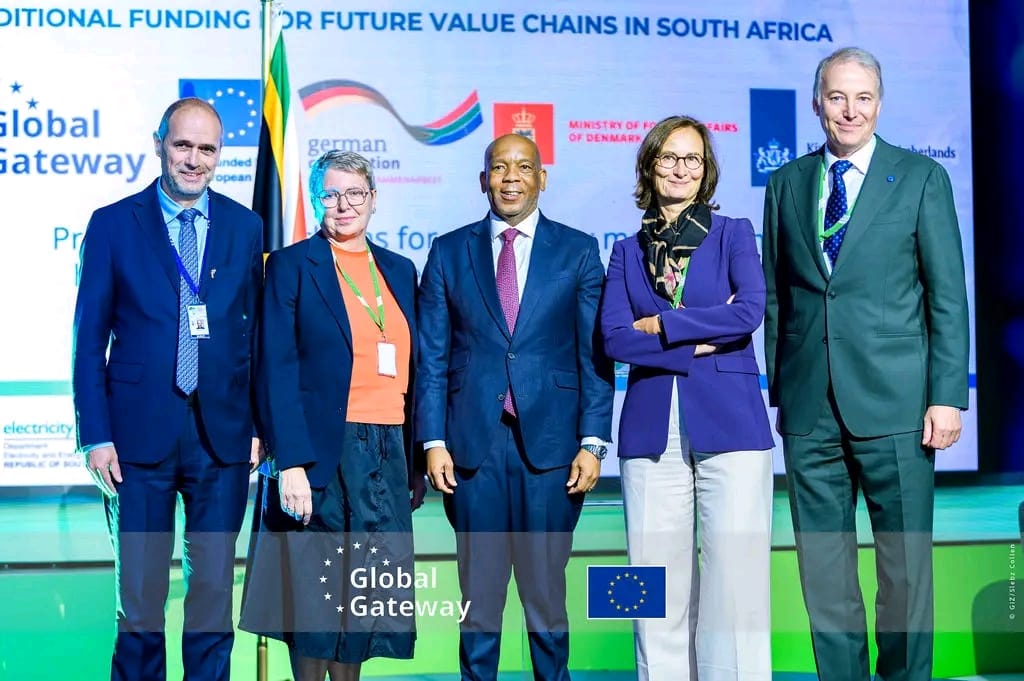
Launched at the African Green Hydrogen Summit in Cape Town, the initiatives have a combined value of €57.8 million and bring together the European Union, Germany, Denmark and the Netherlands, working with South African institutions. They form part of the broader Team Europe Global Gateway Investment Package announced in October 2025.
European Union Commissioner for International Partnerships Jozef Síkela said the programmes were designed not simply to provide public financing, but to create conditions capable of attracting significantly greater private investment into emerging industries.
“These two Global Gateway projects show how Team Europe, together with South Africa, can create the right conditions for private investors to enter markets with high potential and deliver solutions that boost sustainable development,” Síkela said.
“By mobilising investments in renewable hydrogen, sustainable minerals and metals value chains, it supports the transformation of South Africa’s renewable energy potential into benefits for its companies and people with quality jobs in a competitive and decarbonised industry.”
Building value chains at home
The larger of the two initiatives, valued at €37.3 million — approximately R690 million — focuses on promoting value chains for critical raw materials, green hydrogen and their derivatives.
European partners include the EU, Denmark, the Netherlands and Germany through the Federal Ministry for Economic Cooperation and Development, with implementation by GIZ. South Africa’s Department of Electricity and Energy is the principal national partner.
The programme will work across South Africa, with particular attention to the Northern Cape, Limpopo and Mpumalanga.Its interventions include strengthening strategy, policy and regulatory frameworks, encouraging private-sector cooperation and finance, supporting research and development and building institutional and technical capacity.
The programme also places the just energy transition within the wider industrialisation discussion. The objective is not only to develop new sources of clean energy, but to increase the economic activity that takes place within South Africa as minerals and energy resources move through their respective value chains.
Mobilising capital for green hydrogen
A second project, backed by a €20.5 million grant — about R370 million — will establish a financing facility intended to unlock grant, equity and concessional capital for green hydrogen investment.
The EU and Germany’s KfW Development Bank are partnering with the Development Bank of Southern Africa (DBSA) on the initiative, which will combine EU grant funding with development finance from KfW.
The structure is intended to mobilise additional capital from public and private investors while drawing on DBSA’s experience in identifying and financing Power-to-X projects — technologies that convert renewable electricity into products such as hydrogen and hydrogen-derived fuels.
Unlike the first programme’s particular regional emphasis, the financing facility will have a nationwide geographical scope.
From resources to industrial opportunity
Together, the projects reflect an increasingly important question surrounding Africa’s energy transition: how countries rich in renewable energy potential and strategic minerals can capture a larger share of the economic value generated from those resources.
For South Africa, this means developing the policies, financing mechanisms, research capacity, skills and industrial infrastructure required for green hydrogen, battery materials and minerals to support domestic economic activity rather than functioning primarily as export commodities.
The initiatives are expected to strengthen environmental, social and governance frameworks, facilitate access to finance, promote private-sector participation and increase investment in industrial research, development and innovation.
They also sit within a much larger financing relationship. The Team Europe Global Gateway Investment Package for South Africa, announced in October 2025, is valued at more than R200 billion.
The latest projects therefore represent a relatively small portion of that package, but provide an indication of how the broader commitment is being translated into specific programmes.