

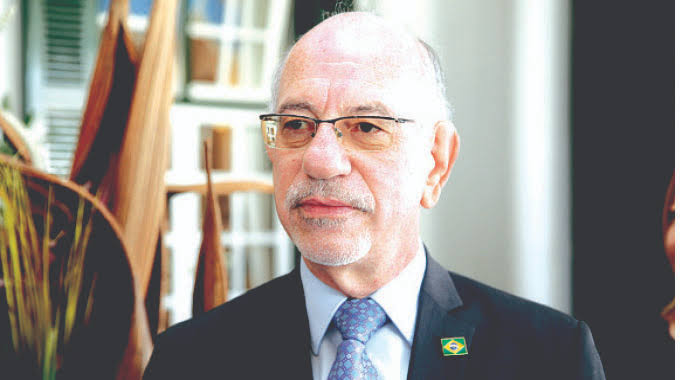
The Diplomat Couch sat down with H.E. Vilmar Rogeiro Coutinho Junior, Ambassador of Brazil to Zimbabwe, to discuss the longstanding relationship between Brazil and Zimbabwe and opportunities to deepen cooperation in trade, agriculture, investment, education, sports and culture. With diplomatic relations dating back to Zimbabwe’s independence in 1980, the two countries have maintained strong political ties and share similar positions on a range of international issues. In this edited interview, the Ambassador discusses Brazil’s support for Zimbabwe’s multilateral ambitions, agricultural and technical cooperation, opportunities for investment and industrial development, and efforts to strengthen people-to-people and cultural exchanges between the two countries.
The Diplomat Couch is a television programme produced by The Diplomat Africa.
How would you characterise the current state of Brazil-Zimbabwe relations in 2026, and what has remained constant since 1980?
The state of relations between the two countries is excellent, and it has always been. If you wanted to know something that has remained constant from 1980 until the present day, that would be it.
The relations have remained very good. Brazil and Zimbabwe share almost the same positions and views on practically every issue on the international agenda.
In terms of bilateral relations, however, I believe we still have some work to do. Historically, the two countries have been somewhat apart for several reasons, and we still need to work on bringing them closer together.
What would you say are the strongest pillars of the bilateral relationship today?
We still have some work to do because, historically, the two countries have been quite apart for several reasons. But the potential for increased trade and investment relations is certainly there.
There is also a lot of potential culturally. I feel that Zimbabweans do not know much about Brazil, even though they appreciate Brazil very much.
And the other way around as well. In Brazil, people do not know much about Zimbabwe. So we still need to work a little bit to make people on both sides know more about each other.
That is important because, once people know each other better, they can start thinking of each other as potential trade partners, investment partners and partners in other areas.
What is the biggest priority for Brazil in strengthening its relationship with Zimbabwe over the next few years?
We see many opportunities for cooperation in trade, particularly in pharmaceuticals, agriculture and industrial machinery.
We would also like to be seen as a good partner in helping develop new industries here in Zimbabwe.
For instance, at this moment, I am engaging with the Zimbabwe Sugar Association because we are discussing the possibility of Brazilian groups coming here to invest in the sugar sector.
This would not only be about increasing sugar production, but specifically about increasing ethanol production. Brazil is well advanced in this area, and we are prepared and eager to help Zimbabwe reach more advanced levels in that industry.
Beyond trade, where do you see greater potential for cooperation between Brazil and Zimbabwe?
The cultural area is certainly one.
It would be good if we could see more Brazilian artists coming here, and it would also be good to have Zimbabwean artists visiting Brazil.
Last year, we had Zimbabwean artists participating in the São Paulo Biennial, which is probably the second-largest exhibition of its kind in the world. It was very successful, and a Zimbabwean sculpture had an excellent participation at that exhibition.
So there are opportunities, and we need to continue building on them.
When it comes to trade, industry and mining, what are the flagship Brazil-Zimbabwe agricultural programmes currently underway, and which initiatives have delivered measurable results for farmers?
In terms of technical cooperation, we have the two programmes, particularly in the areas of cotton and livestock. They have been very successful, and we hope to continue that success.
Both are about to finish their first phases, so possibly we will have to negotiate a second phase in both cases.
Brazil is open to any other requests that Zimbabwe may have in terms of technical cooperation involving the two governments.
There are also possibilities for technical cooperation to be negotiated in the private sector. For instance, in the case of ethanol production, the contracts that have been developed so far point in that direction.
Developing an ethanol industry is a complex business because it involves technological exchange, training programmes and other forms of cooperation. That is exactly what could be conducted if negotiations between private entities on both sides are successful.
Brazil has previously supplied Zimbabwe with agricultural machinery. What opportunities exist to revive or expand cooperation in this area?
We had a very successful programme of selling agricultural machinery here in the past. It was very successful at the beginning, but later there were some problems on the Zimbabwean side, and now we are dealing with outstanding bilateral debt.
We are looking at how we can solve this problem. It creates some difficulty because, until the situation is resolved, we cannot extend new concessionary or official credits.
That does not prevent private credit from being extended, and we are also working on that.
Agricultural machinery exports definitely constitute one of the sectors presenting the best opportunities for trade to be developed between the two countries. But there are also opportunities in industrial machinery and other areas, including pharmaceuticals.
How is Brazil’s agricultural expertise being transferred to Zimbabwe through trade and technical cooperation?
The two technical cooperation programmes encompass this as well.
In the past, there have been missions where people were sent from Zimbabwe to Brazil to receive training. We have also brought Brazilian technicians here to conduct training programmes.
The most recent programme was this year, and it is still ongoing. There will be other exchanges like this in the coming months.
What support is available to help Zimbabwean businesses and farmers meet Brazilian import standards and certification requirements?
For industrial products, I believe it would be difficult, but not necessarily for the reasons you mentioned. The issue is that it would be difficult for Zimbabwean products to reach the Brazilian market competitively.
The same applies in the other direction. Brazil is a major agricultural exporter in the world, but Zimbabwe is not necessarily a market for many Brazilian agricultural products because Zimbabwe produces almost all the same agricultural products that we do.
There was, for instance, a situation in 2024 when Zimbabwe was affected by a severe drought and there were imports of Brazilian maize into the country. But those were exceptional circumstances. Under normal circumstances, Brazilian maize would not arrive here at a competitive level.
So we concentrate more on other areas where cooperation makes greater sense. For instance, in meat processing, there is potential for cooperation because productivity levels here are below those in Brazil.
But we do not want to undermine the meat industry in Zimbabwe. On the contrary, we want to help it increase its levels of productivity. So there is scope for cooperation there.
Looking ahead, which sectors outside agriculture do you see scaling first, and what is the realistic goal for bilateral trade in 2026 and 2027?
We first need to overcome the difficulties that have resulted in our bilateral trade remaining relatively low.
Other than the sectors I have mentioned, there are other areas that may offer good opportunities, although we still need to identify them.
We can think of some Brazilian products reaching the Zimbabwean market, probably on a limited scale. For instance, the Brazilian footwear industry is very strong, and there could be opportunities there.
The other way around is more difficult, as I said, for Zimbabwe to think of exporting certain products to Brazil. But nothing is impossible. It is all a matter of finding out where the opportunities are.
Another area where cooperation could take place and lead to a lot is tourism. And when we talk about tourism, I am not talking only about infrastructure. I am also talking about supplies for the tourism industry.
What opportunities exist for Zimbabwean students and professionals to study or train in Brazil, and how can they access those programmes?
I recently had a meeting with the Minister of Higher and Tertiary Education, Innovation, Science and Technology Development, and we tabled a proposal. If we establish a bilateral agreement of cooperation in that area, this will immediately open the door for Zimbabwean students to apply for scholarships and visit universities.
At the moment, they cannot participate in certain programmes because we do not have this bilateral agreement.
There is also an offer by the Brazilian Government, as well as a group of universities in Brazil that have their own programmes involving both private and public universities. Some Zimbabwean students have been able to obtain scholarships through these arrangements, although very few, and we want to improve and increase that.
Recently, in June, there was a meeting in Brazil convened by the Brazilian Minister of Education. Ministers of Education from African countries, representatives of universities in Africa and a number of universities from Zimbabwe were invited.
Five or six Zimbabwean universities sent delegates to the meeting, and they came back with 11 MOUs signed with Brazilian universities.
Once these MOUs start being implemented, we expect to see more cooperation in this area — not only involving students, but also exchanges of teachers, joint programmes, joint research and other initiatives.
We want that to happen, and we are very optimistic that we can make progress in this area very quickly.
You mentioned education and cultural exchange. What about sports as another area of people-to-people cooperation?
Sports is another area that has not really been touched yet.
Coincidentally, I recently attended a football match here, and there is now a Brazilian player playing in Zimbabwe. We hope that he will be the first of a group of Brazilian athletes to come in the next few months.
This could give us a greater presence of Brazilian athletes playing here and open the door for cooperation in other sports as well.
This is also something I have already discussed with the Ministry of Sports, although we still have to work a little bit more on it.
Brazil has a strong reputation in areas such as tropical medicine, sports science and the creative arts. Are there exchange programmes or scholarships targeting these fields?
I do not know of specific programmes at this moment, but this is certainly on the cards within the framework of the agreements and the MOUs signed directly between universities.
These areas could also become part of the cooperation that develops through those arrangements.
We also expect cultural initiatives to contribute to this. In September, there is expected to be a theatre festival here, and I hope it is confirmed.
As far as I know, it would be the first experience of this kind because I do not think a Brazilian theatre group has ever come to Zimbabwe.
If it goes ahead and is successful, we expect other initiatives like that to take place.
But we also need to get Zimbabwean artists to Brazil. Last year there was one, and now we need to think of others as well.
How is the embassy working to strengthen cultural exchange between Brazilian and Zimbabwean communities?
We are talking to the Ministry of Sports, which is also responsible for arts and culture, to see what kind of cooperation we can establish.
But one thing is to establish cooperation here in Zimbabwe. The other is to encourage the private sector, private enterprises, private initiatives and private groups to engage as well.
That is part of the broader effort to bring the two countries closer together.
The two countries have a very positive image of each other, but they do not know enough about each other. That is exactly what we need to work on — to change that situation.
What role do Zimbabweans living in Brazil and the Brazilian community in Zimbabwe play in deepening mutual understanding between the two countries?
There we have a difficulty. There is no significant Zimbabwean diaspora in Brazil. There may be a few Zimbabwean citizens living in our country, but there is no established Brazilian community here either.
Actually, coincidentally, we are preparing for our National Day Reception, which will be on 7 September, and I was reviewing the list of Brazilian citizens living in Zimbabwe.
We found that there are only 15, including the five Brazilians who work at this embassy. So, outside the embassy, there are only about 10 Brazilians living in Zimbabwe.
So we cannot really talk about a Brazilian community.
Is the embassy actively engaging with the Brazilians living in Zimbabwe to support them and strengthen their connection with the embassy?
Most of them have businesses, and some are involved in religious activities. They are engaged in their own activities and are also scattered around the country.
Here in Harare, there are only two of them, which makes it difficult for us to engage them in our activities.
But we try to keep them informed, and they also try to help us by bringing information and pointing out opportunities, whether on the commercial side, the social side or in terms of arts.