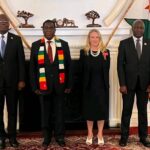



The Diplomat Couch sat down with H.E. Dr. Maha Serag El-Din Moustafa Kamel, Ambassador of Egypt to Zimbabwe, to discuss the longstanding relationship between the two countries and opportunities to deepen cooperation in trade, investment, infrastructure development and human capital development.
The discussion traces Egypt’s support for Zimbabwe during the liberation struggle and explores how the two countries are working to translate their historical ties into practical economic opportunities. The ambassador also discusses pharmaceutical manufacturing, paediatric heart surgery, the development of Mount Hampden, skills transfer and Egypt’s experience in urban development, energy and agriculture.
The Diplomat Couch is a television programme produced by The Diplomat Africa.
Egypt was among the countries that supported Zimbabwe during the liberation struggle. How would you describe the evolution of relations between the two countries, from that period to where they stand today?
Thank you for that introduction. You have rightly described our relationship, which dates back to the 1960s, during Zimbabwe’s liberation struggle.
Egypt was among the first countries to support Zimbabwean freedom fighters in their struggle against colonialism. We hosted some Zimbabwean leaders in Cairo during that period, something we appreciate and are very proud to have contributed to.
More importantly, Egypt advocated for Zimbabwe and its people in international forums, including the United Nations, supporting the country’s liberation. This was an important cause for us, shaped by our own historical experience, particularly the 1952 revolution, through which we reclaimed sovereignty, dignity and freedom. We understood what the Zimbabwean people were fighting for because it was also a cause we identified with.
Following Zimbabwe’s independence, Egypt was among the first countries to establish diplomatic relations with Zimbabwe. We opened our embassy here shortly after independence because we were waiting for that moment to begin formal diplomatic relations.
Forty-six years after independence, our bilateral relations continue to grow. I would say we are now entering an accelerated phase of partnership, expanding people-to-people and business-to-business cooperation while building on the strong political and economic relations between our governments.
Beyond bilateral relations, how does Egypt view Zimbabwe’s role in advancing African integration and South-South cooperation through COMESA, the African Union and other continental platforms?
We do not see Zimbabwe as just another country in advancing African economic integration. We see Zimbabwe as a neighbour and a partner.
Over the years, we have seen Zimbabwe successfully lead regional and continental initiatives. We are also looking forward to working with Zimbabwe during its COMESA presidency, which presents opportunities to strengthen regional cooperation.
We have also witnessed the confidence placed in Zimbabwe through its election as a non-permanent member of the United Nations Security Council for the 2027–2028 term. Egypt strongly supported Zimbabwe’s membership.
This will provide an important opportunity for us to work together to advance African priorities and present African solutions to global challenges. Our continent is significantly affected by these challenges, making it important for African countries to coordinate their approaches and ensure that their priorities are represented internationally.
Egypt and Zimbabwe have maintained strong political relations over the years. How is that political goodwill being translated into practical cooperation in trade, investment, healthcare and skills development?
Before addressing this, I would like to highlight an important development. Egypt is hosting the African Union Mid-Year Summit alongside the inaugural Alamein Africa Business Forum. We are proud that Zimbabwe will participate in the business forum with a high-level business delegation.
This will provide a valuable opportunity for business-to-business meetings and for exploring further cooperation in trade and manufacturing.
There is enormous potential for cooperation that has not yet been fully tapped, particularly by the private sector. In recent years, bilateral trade has nearly doubled, but it remains below its potential.
Egyptian products entering the Zimbabwean market include cereals, electrical equipment, pharmaceuticals and machinery. However, there are still many opportunities for businesses in both countries to expand trade.
We see trade as an initial phase of cooperation. Manufacturing is particularly important as Zimbabwe enters a new economic phase with opportunities for investment and industrial development. Given Zimbabwe’s strategic location in the heart of Southern Africa, there is potential for the country to become a regional hub.
We want to encourage Egyptian businesses to invest, establish manufacturing operations and contribute to Zimbabwe’s economic transformation.
Where do you see the greatest opportunities for Egyptian and Zimbabwean businesses to increase trade and investment, particularly in sectors where the two countries have complementary strengths?
Manufacturing is a very promising area, especially pharmaceutical manufacturing.
Over the past three years, we have explored opportunities in Zimbabwe’s pharmaceutical market. We now want to take this relationship to a higher level through manufacturing partnerships, which could help Zimbabwe develop into a pharmaceutical and healthcare hub for the Southern African region.
Recently, working with Egypt’s Export Council for Medical Industries, we hosted a delegation of more than 15 Egyptian companies involved in pharmaceuticals, medical equipment, human and veterinary vaccines, hospital furniture and laboratory equipment.
The delegation held successful meetings with Zimbabwean businesses, and we hope these engagements will lead to further cooperation and partnerships.
Another important area is paediatric open-heart surgery. In recent years, Egyptian medical professionals have travelled to Zimbabwe to perform these procedures in cooperation with Parirenyatwa Group of Hospitals.
One of the most valuable aspects of this partnership has been seeing Egyptian and Zimbabwean doctors work together. The impact on children and their families demonstrates why cooperation must deliver practical benefits to ordinary citizens.
We do not want our partnerships to end with the signing of memoranda of understanding or the exchange of official communications. We want people in Zimbabwe and Egypt to feel the benefits of our cooperation.
We have also organised training programmes for Zimbabwean government officials through the Egyptian Agency of Partnership for Development. These programmes cover areas including technology transfer, artificial intelligence, investment promotion, economic development and crisis management.
We have been impressed by the quality of Zimbabwe’s human capital and want to build on that by sharing Egypt’s experience and expertise.
Egypt has experience in developing large-scale cities. What does the memorandum of understanding between Egypt’s Administrative Capital for Urban Development and Zimbabwe’s New City Development seek to achieve, and what can Zimbabwe learn from Egypt’s experience?
Thank you for raising this important issue. The memorandum of understanding was signed between Egypt’s Administrative Capital for Urban Development and the Zimbabwean Government in July 2022.
It establishes a framework for government-to-government cooperation in the planning, design and construction of the new city, with the aim of creating opportunities for private-sector participation in subsequent stages of implementation.
Egypt has successfully developed its New Administrative Capital, which is now operational as the country’s administrative centre. There is considerable experience we can share with Zimbabwe.
One lesson is the importance of phased development. A project of this scale cannot be implemented overnight. It takes years of planning and implementation, beginning with essential infrastructure, followed by government facilities, residential areas and commercial zones.
Another important area is technology integration. A smart city involves much more than buildings. It requires modern government systems, efficient utilities, sustainable transportation and coordinated urban planning.
Institutional capacity building is also essential. Equally important is attracting and mobilising private-sector investment. Relying exclusively on government resources to deliver a project of this scale would place a significant burden on public finances.
We are keen to share our experience with Zimbabwe, not to dictate what should be done, because every country has its own circumstances and sovereign right to determine its development priorities, but to provide support and practical assistance.
Many of the challenges Zimbabwe faces today are challenges Egypt has experienced and worked to address. We believe our experience can be useful as Zimbabwe develops solutions suited to its own needs.
What development and capacity-building programmes is Egypt supporting for Zimbabwe, particularly in healthcare, agriculture, education, investment and technical skills?
Our technical capacity-building arm is the Egyptian Agency of Partnership for Development.
It is important to emphasise that our cooperation is demand-driven. We do not impose particular areas of expertise on our partners. Instead, we seek to tailor our programmes to the needs of African countries, including Zimbabwe.
Over the years, we have provided a diverse range of training programmes covering crisis management, cybersecurity, cybercrime, artificial intelligence, water management, irrigation and urban planning, among other areas.
These programmes also provide government officials with opportunities to visit Cairo and gain practical exposure to developments and experience in Egypt.
We want these exchanges to help participants acquire knowledge and skills that they can apply in their respective institutions and contribute to Zimbabwe’s development.
Looking ahead, what are the key areas where you would like to see Egypt-Zimbabwe cooperation deepen over the next few years?
There are many areas to explore. Construction is one of them because Egypt has considerable experience in this sector and has cooperated with several other African countries.
We have observed the development taking place in Zimbabwe over the past few years, particularly in construction. As an embassy, we are keen to communicate these developments to Egypt and highlight the opportunities emerging in Zimbabwe.
Manufacturing is another priority for both countries. Moving beyond trade towards joint investment and manufacturing would take our cooperation to a new level. This could involve Egyptian engineers, entrepreneurs and businesses establishing a presence in Zimbabwe.
Energy is also crucial. Development cannot take place without reliable energy, and Egypt has made significant progress in this sector over the past decade. We believe there may be opportunities to share experience and explore approaches that could be adapted to Zimbabwe’s circumstances.
Infrastructure development is equally important. Zimbabwe’s economic ambitions require investment in roads, transport systems and other essential infrastructure. Egypt has experience in infrastructure development that could support cooperation in this area.
Agriculture is another important sector. Egypt has expertise in irrigation, water management and technology transfer, while Zimbabwe has a strong agricultural base, land and water resources. These complementary strengths create opportunities for collaboration.
Ultimately, we want our cooperation to support Zimbabwe’s development priorities while creating practical opportunities for both countries.
As your term in Zimbabwe continues, what have you found most fulfilling or enjoyable about your experience in the country?
Since arriving in Zimbabwe, I have been pleasantly surprised on many occasions. The people are friendly and resilient, which is something I noticed from the beginning.
Zimbabwe also has many tourist attractions beyond Victoria Falls. There are numerous hidden gems that could attract visitors from around the world.
I have visited Victoria Falls, and it was a wonderful experience. What stands out most for me, however, is the people of Zimbabwe and the warmth with which they receive others.